


IVF Clinic Software: The Complete Guide for Fertility Teams

Fertility clinics run on a schedule that does not bend. A stimulation cycle moves whether or not the paperwork has caught up, and a scan result that sits unread for six hours can change a dose, a retrieval date, or an outcome. Software for this setting has to hold a long, dependent sequence of events together across reception, clinical, laboratory and finance teams, and it has to do it without losing the thread when a cycle is cancelled, converted or repeated.

This guide walks through what an IVF clinic system actually covers, module by module, and what separates a system that fits fertility work from a general practice tool with a fertility label on it. It is written for clinic directors, embryology leads and practice managers who are scoping a first system or replacing one that has stopped keeping up.

1. What IVF clinic software actually covers

The phrase covers more ground than most buyers expect. At minimum it means a patient record built around cycles rather than isolated visits, a scheduler that understands theatre and laboratory capacity, and a billing layer that can split costs across partners and funding sources. Larger deployments add embryology records, consent and witnessing, inventory, stock, analytics and regulatory reporting.

Clinics usually meet these capabilities in one of three shapes: a single platform covering the whole clinic, a core record with bolt-on modules, or a set of separate tools stitched together. The third is the most common starting point and the most expensive to unwind later, because the joins between tools are where data quality quietly degrades. A single integrated platform avoids most of those joins, though it trades some best-of-breed depth in individual modules.

2. Centralised patient records

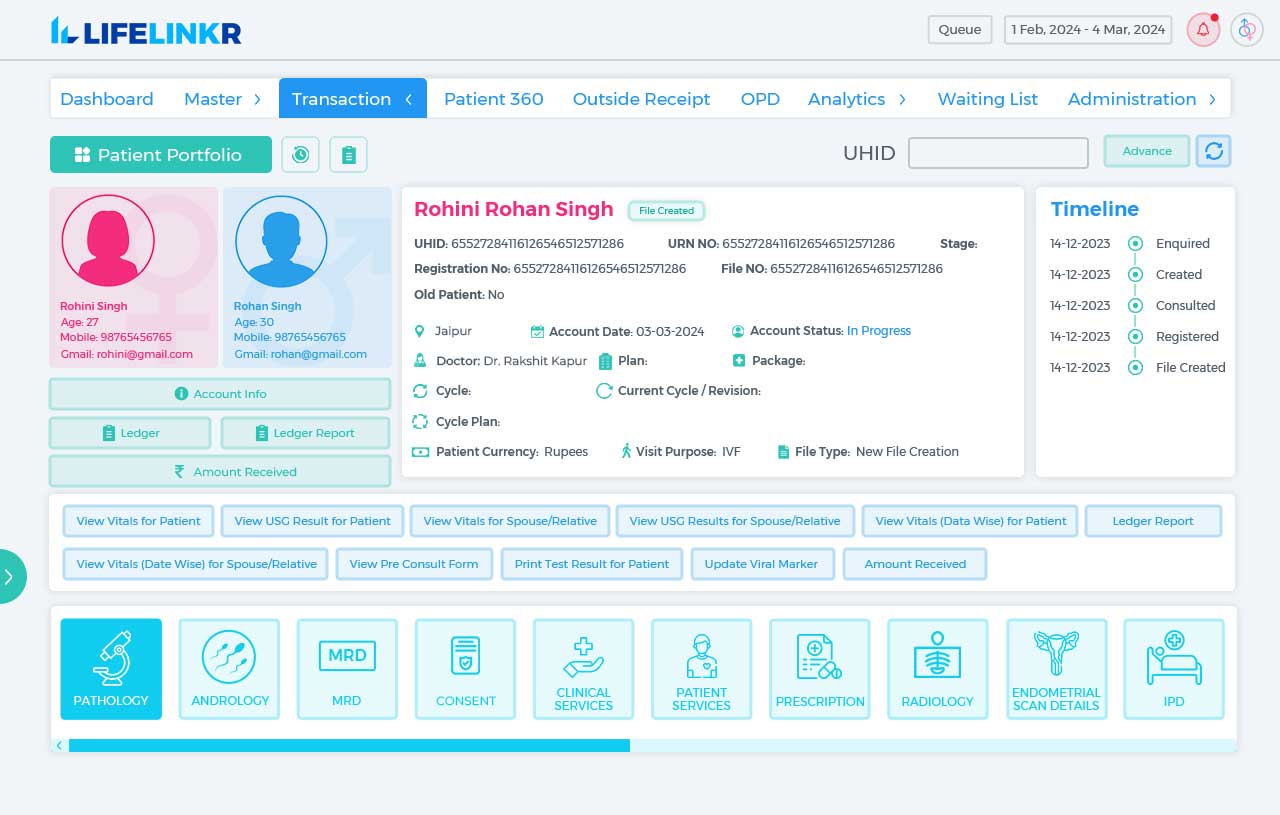
A fertility record is not one chart. It is two people’s histories, often with different clinical routes into the same cycle, plus donor or surrogate records where they apply. Anything that treats the couple as one patient loses information; anything that treats them as unrelated makes staff cross-reference by hand.

What matters practically is whether a clinician can see the full arc on one screen: previous cycles, protocols used, response, complications, and what was decided afterwards. When that history is scattered across attachments and scanned letters, clinical decisions get made on partial information and repeat tests get ordered because nobody could find the first result. A consolidated view of a patient’s history is the foundation the rest of the system rests on.

3. Treatment cycle tracking

Cycle tracking is the part most general-purpose systems get wrong. A cycle is a state machine with defined stages — down-regulation, stimulation, trigger, retrieval, fertilisation, transfer, luteal support, outcome — and each stage has its own timing rules, monitoring requirements and decision points.

Good software makes the current stage visible at a glance for every active patient, flags the ones due for a scan or blood test today, and records why a protocol changed rather than just that it did. It also has to handle the untidy cases properly: cycles abandoned before retrieval, freeze-all decisions, and frozen transfers that occur months later but belong to the earlier stimulation. Systems that model only the happy path force staff into free-text notes, and free text is not reportable. Mapping the full arc of a treatment journey is what makes the rest of the clinic’s reporting possible.

4. Appointment and resource scheduling

Fertility scheduling is constrained by biology on one side and finite resources on the other. Monitoring appointments must fall on specific cycle days; retrievals need theatre time, an anaesthetist and an embryologist simultaneously; transfers need a laboratory slot that matches the embryo’s development day.

A scheduler that only books people against a calendar will not catch a retrieval booked when the laboratory is already at capacity. What helps is scheduling against resources rather than just clinicians, with visibility of how a change ripples: moving a trigger shifts a retrieval, which shifts a transfer, which affects three other bookings. Look for appointment scheduling tied to the treatment timeline rather than a standalone diary. Clinics that manage this in a spreadsheet alongside the clinical system usually find the two disagree within a fortnight.

5. Staff coordination and task ownership

Most delays in a fertility clinic are handover failures rather than clinical ones. A result arrives, and it is not clear who is responsible for acting on it. Software helps here by making ownership explicit: every result, message and outstanding action has a named owner and a due time, and anything unclaimed surfaces rather than sitting quietly in a shared inbox.

The test to apply during a demo is simple. Ask what happens to an abnormal result received at 6pm on a Friday — who sees it, who is notified, and what the system does if nobody acknowledges it. The answer tells you more about day-to-day safety than any feature list.

6. Patient communication

Fertility patients are anxious, well-informed and in frequent contact. They need dose reminders that arrive at the right hour, results explained in plain language, and a reliable way to ask a question without phoning reception four times.

Communication that runs through the clinical record — rather than a separate messaging tool — means the conversation is visible to whoever picks the patient up next, and consent, instructions and confirmations are all attached to the cycle they belong to. Clinics that also run outreach and recall campaigns generally want structured patient messaging and campaign tools alongside the day-to-day clinical messaging, kept clearly separate so that clinical instructions never sit in a marketing queue.

7. Real-time access across sites and roles

Satellite monitoring is now normal: a patient is scanned near home and treated at the main centre. That only works if the scan result is visible at the treating site within minutes, not by the next working day.

The requirement is not simply remote access but current data with a clear provenance — who entered a measurement, when, and at which site. Where clinics run overnight or across time zones, the same requirement extends to the laboratory, where a fertilisation check recorded at 7am has to be visible to the clinical team immediately. Live operational dashboards are the usual way this gets surfaced to managers, but the underlying need is simply that no team is working from yesterday’s picture.

8. Billing, invoicing and payments

Fertility billing is unusually complicated. A single cycle may combine self-funded elements, insurance cover, employer benefit schemes and public funding, with different rules about what each will pay for. Add-ons are chosen mid-cycle. Drugs are often billed separately from procedures. Refunds and shared-risk packages have their own logic.

A system that handles this well ties charges to clinical events, so that a cancelled cycle automatically reflects what was and was not delivered, and it can split an invoice between two partners without duplicating the underlying record. A system that handles it badly produces invoices that the finance team rebuilds by hand each month — which is the single most common reason clinics tell us their software has stopped scaling. Our billing and payments module is built around that sequence, from stage-wise advances through to GST-ready returns.

9. Financial visibility and cost control

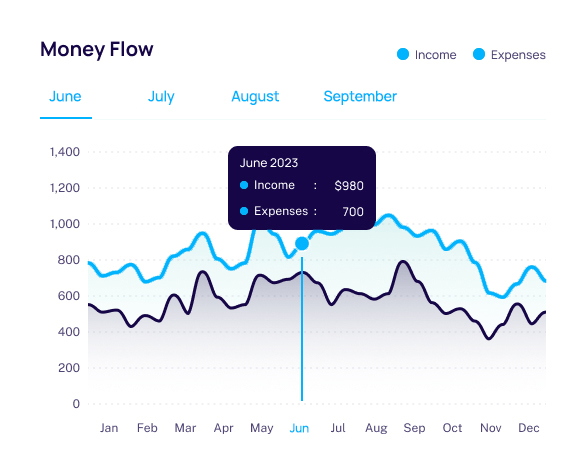
Beyond issuing invoices, clinic leadership needs to know which activities actually make money. Cost per cycle, consumable spend per retrieval, theatre utilisation and the true cost of cancelled cycles are all knowable, but only if clinical and financial data share a spine.

This is where a lot of clinics discover they have been running on impressions. Once cycle costs are attributed properly, the picture is often different from what people expected — particularly around cancellations and freeze-all pathways. If you are building a business case for a system, a structured way to model the return before committing is more persuasive than a feature comparison.

10. Laboratory workflow and sample traceability

The embryology laboratory has requirements no general clinical system meets. Every gamete and embryo needs an unbroken chain of custody, with witnessing recorded at each transfer point between vessels, operators and storage. Development is graded at fixed intervals. Cryostorage needs location down to the individual straw or vial, plus the tank, canister and position.

Traceability is the non-negotiable part, and it is a regulatory requirement in most jurisdictions rather than a nicety. If witnessing lives on paper while everything else is digital, the laboratory carries the clinic’s compliance risk on a clipboard. A dedicated laboratory workflow module is worth insisting on rather than accepting a general notes field.

11. Inventory, consumables and pharmacy

Fertility clinics hold expensive, temperature-sensitive, short-dated stock: gonadotrophins, culture media, catheters, cryo consumables. Running out mid-cycle is not a procurement inconvenience, it is a clinical event.

Useful inventory handling ties consumption to the cycle that used it, so stock depletes as work happens rather than at a monthly count, and it warns on expiry before the batch is unusable. Where clinics dispense drugs directly, pharmacy and stock control also has to reconcile what was prescribed, dispensed, returned and charged — three of which routinely disagree when tracked separately.

12. Reporting, KPIs and analytics

Every fertility clinic reports outcomes, internally and usually to a regulator or registry. The metrics are well established — fertilisation rate, blastocyst conversion, implantation rate, clinical pregnancy per transfer and per started cycle, cumulative live birth rate per retrieval — and the difficulty is never the arithmetic. It is whether the denominators are consistent.

Reporting that is built on the clinical record, rather than compiled separately, means the numbers reconcile and the definitions stay stable when staff change. It also means outcome data can be segmented honestly by age band, protocol and indication, which is the only way to tell whether a change in practice actually improved anything. Outcome measurement and benchmarking reports are the layer that turns a clean record into something you can act on.

13. Predictive analytics and AI assistance

Machine learning has real, narrow uses in fertility care: grading embryo images consistently, flagging cycles trending toward poor response early enough to adjust, and estimating the likely number of cycles a couple will need. Used carefully, these support a clinician’s judgement and improve consistency between operators.

They do not replace clinical decision-making, and any vendor implying otherwise deserves scepticism. The questions worth asking are what the model was trained on, whether its performance holds for your patient population, and whether a clinician can see and override the reasoning. AI-assisted features are best evaluated as decision support with a clear audit trail, not as automation.

14. EMR and EHR integration

Fertility clinics rarely operate in isolation. Referrals arrive from gynaecology and urology, patients continue into obstetric care after a positive outcome, and hospital-based units sit inside a larger institutional record.

Integration depth varies enormously. At the shallow end, documents are exchanged as PDFs; at the deep end, results and problem lists flow structurally in both directions. Both are legitimate depending on scale, but it is worth being clear which one is on offer before signing. If you are moving off an existing system, plan the migration of historical records as a project in its own right — historic cycle data is exactly what makes outcome reporting credible, and it is the part most often abandoned when a migration runs late.

15. APIs and interoperability

An API turns a closed system into one you can build around: pushing appointment data into a patient app, pulling laboratory analyser results in automatically, syncing enquiries from a website form, exporting to a registry submission. Without one, every connection becomes a manual export.

What to check is not whether an API exists — nearly every vendor says yes — but whether it is documented, versioned, authenticated properly, and covers the objects you actually need rather than a token subset. API-level integration is also what keeps the enquiry-to-consultation path intact when marketing and clinical tools are separate; clinics that track this end to end usually pair it with enquiry and lead handling inside the same system.

16. Security, privacy and regulatory compliance

Fertility records are among the most sensitive categories of health data, and they involve people who are not the patient — partners, donors, and in some arrangements a surrogate — each with their own consent and disclosure rules.

The baseline expectations are role-based access so staff see only what their job requires, encryption in transit and at rest, an audit trail that records reads as well as writes, and retention that matches the long statutory periods applying to gamete and embryo records. Consent is its own discipline here: it must be versioned, time-stamped, withdrawable, and linked to the specific material it governs. Data protection controls are worth reviewing against your own regulator’s requirements rather than a generic checklist, since obligations differ substantially between jurisdictions.

17. Cloud delivery, remote access and maintenance

Most new deployments are cloud-hosted, and for good reasons: no server to maintain on site, updates applied centrally, and access from satellite units without a private network. The trade-offs are worth stating plainly rather than glossing over.

You are dependent on connectivity, so ask what happens during an outage — particularly in the laboratory, where work does not stop. You are dependent on the vendor’s release cadence, so ask how updates are tested and whether you can defer one mid-cycle. And you should know where data physically resides, because data residency is a legal constraint in several markets. On-premise deployment still makes sense for some hospital-based units; it simply moves the maintenance burden rather than removing it.

18. Customisation, scalability and choosing a system

No two fertility clinics run identical protocols, and a system that cannot accommodate local practice will either be worked around or abandoned. But there is a meaningful difference between configuration — changing fields, stages, templates and permissions within supported limits — and true customisation, which means bespoke code that someone has to maintain through every future upgrade. Prefer the first wherever it will do the job; a platform that is configurable to your clinic’s own workflow costs far less to own over five years.

On scale, the questions are whether the system supports multiple sites with shared patients, whether performance holds as historical data accumulates, and whether pricing steps punish growth. When you evaluate, insist on seeing your own scenarios rather than a scripted tour: a cancelled cycle, a split invoice, a frozen transfer from a cycle two years ago, and a compliance report. Compare the full feature list against that, and treat anything that requires a workaround in the demo as something that will require a workaround every day.

Bring your own scenarios to a walkthrough. Book a session with our team and hand us the hard ones — the abnormal result at 6pm on a Friday, the invoice split between two partners, the frozen transfer from a cycle two years ago — and judge the system on what it does with them.