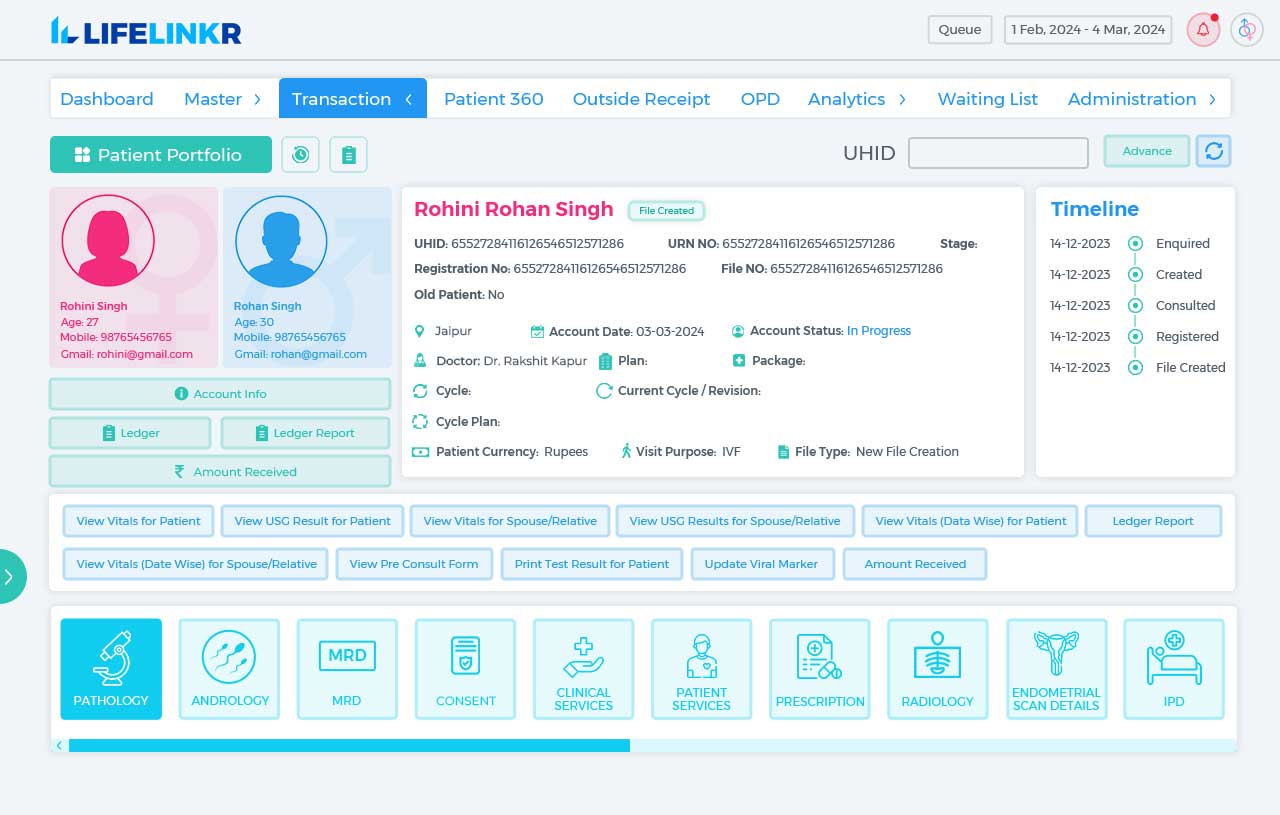
Organizing historical IVF data within digital systems

Digital solutions for organizing data

Table of Contents

Introduction

Fertility clinics accumulate patient data over decades. A patient who first attended a clinic ten years ago may return today for a further treatment cycle, and the clinical team will need to access their full history quickly and reliably to plan the best approach. That history might include multiple stimulation cycles, embryo development records, genetic screening results, cryopreservation inventories, and consent documentation spread across different systems, different software versions, and in some cases paper files that were never fully digitised.

When historical IVF data is well organised within digital systems, it supports better clinical decisions, faster administrative processes, and confident regulatory compliance. When it is scattered, incomplete, or stored in formats that are difficult to retrieve, it creates delays, errors, and gaps in patient care that are hard to explain and harder to correct.

This guide explains why organising historical IVF data matters, what makes it difficult, and what practical steps fertility clinics can take to bring their historical data into a well-structured, accessible, and compliant digital state.

Why Organising Historical IVF Data Matters?

Historical IVF data is not archive material that can be set aside once a treatment cycle ends. It is active clinical information that clinicians return to repeatedly when planning future cycles, reviewing outcomes, and responding to patient questions. A stimulation protocol that worked well three years ago is directly relevant to planning a repeat cycle today. An embryo grading record from a previous cycle informs decisions about frozen embryo transfers years later.

  • Gives clinicians fast access to full treatment histories when planning repeat or frozen embryo transfer cycles
  • Ensures cryopreservation records remain accurate and retrievable for patients with embryos in long-term storage
  • Supports regulatory compliance by making historical records available for audit at any point
  • Reduces the time staff spend searching for records, chasing down missing documents, or reconstructing histories from partial information
  • Builds patient confidence by demonstrating that the clinic has a complete and reliable record of their care

Because fertility patient relationships can span many years and involve multiple treatment episodes, the value of well-organised historical data grows over time rather than diminishing. Every additional cycle a patient completes adds to a history that future clinical decisions will depend on.

The Core Challenge of Managing Historical IVF Data

The main challenge for IVF software teams is that historical data accumulates across multiple systems, formats, and time periods in ways that were not always planned for. A clinic that has been operating for fifteen years may hold data in a current clinic management system, one or more legacy platforms that were replaced during that time, scanned paper records, standalone spreadsheets used before a dedicated system was in place, and external laboratory or imaging archives that were never fully integrated.

Each of these sources uses different data structures, different field names, and different identifier formats. Bringing them together into a single coherent and searchable dataset requires careful planning, consistent data mapping, and a clear governance framework that defines how records from different sources will be standardised and linked.

The challenge is not simply storing old data somewhere accessible. It is organising it in a way that makes it genuinely useful for clinical, administrative, and regulatory purposes across the full range of situations in which it will be needed.

Impact of Poorly Organised Historical Data on Clinics and Patients

When historical IVF data is poorly organised within digital systems, the effects are felt across every part of the clinic’s work:

  • Clinicians spend time at appointments trying to piece together a patient’s history from incomplete or fragmented records rather than reviewing a clear and complete summary
  • Laboratory teams face uncertainty when a patient requests information about stored embryos and the cryopreservation records cannot be located quickly or contain inconsistencies
  • Administrative staff cannot respond efficiently to patient record requests, subject access requests, or regulatory audit queries when the relevant data is held across multiple disconnected sources
  • Regulatory submissions may be incomplete or inaccurate because historical cycle data from legacy systems was never fully migrated into the current reporting platform
  • Patients who ask about their historical treatment receive slow or incomplete responses that undermine confidence in the clinic’s record-keeping

These problems grow worse over time if they are not actively addressed. A clinic that defers historical data organisation for another year adds another year of accumulating disorganisation on top of what already exists.

Types of Historical IVF Data Held in Digital Systems

Understanding what historical data a clinic holds and where it currently lives is the starting point for any organisation effort. A thorough data inventory should cover all of the following categories.

  • Patient demographic and registration records including name, date of birth, contact details, and identification numbers used across different systems
  • Completed IVF cycle records covering stimulation protocols, monitoring data, egg collection outcomes, fertilisation records, embryo development logs, and transfer details
  • Frozen embryo transfer cycle records linked to the original stimulation cycle from which the stored embryos were created
  • Cryopreservation inventories showing what is stored, where it is stored, when it was stored, and any consent or expiry information associated with each item
  • Genetic screening results from preimplantation genetic testing performed during previous cycles
  • Outcome records including pregnancy test results, clinical pregnancy confirmations, and live birth outcomes
  • Consent documentation and treatment agreements signed at different points in the patient relationship
  • Donor and recipient linkage records maintained under the clinic’s donor programme
  • Correspondence, referral letters, and external clinical reports associated with past treatment episodes

Each category may have different retention requirements, different access controls, and different levels of completeness depending on when and how it was originally recorded. A tiered approach to data organisation that reflects these differences allows the most clinically and regulatorily critical data to be prioritised.

Deep Dive: How Historical IVF Data Becomes Disorganised Over Time

Historical data disorganisation in fertility clinics typically builds up through a combination of system changes, growth, and the normal passage of time rather than through a single event or decision. When a clinic moves from one software platform to another, the data migration is often focused on current and recent patients rather than the full historical archive. Older records may be migrated incompletely, left in the legacy system, or exported to flat files that are stored somewhere on the clinic’s network without a clear structure or retrieval process.

Clinic growth compounds the problem. A single-site clinic that expands to multiple locations may find that each site developed its own filing and recording conventions before a shared system was introduced. Paper records from early years may have been scanned and stored as image files without optical character recognition, making them searchable by file name only rather than by content. Standalone spreadsheets created to fill gaps in an earlier system’s capabilities may contain clinical data that was never transferred into the main platform.

Over time, the people who created these records and understood their structure move on. Institutional knowledge about where certain data lives, what conventions were used, and how records from different periods relate to each other gradually disappears, leaving the data progressively harder to interpret and use.

Strategies to Organise Historical IVF Data Effectively

Bringing historical IVF data into a well-organised digital state requires a structured programme with clear priorities, defined ownership, and practical steps that can be completed progressively without disrupting current clinical operations.

  • Start with a full data inventory that maps every source of historical patient data, including legacy systems, scanned archives, spreadsheets, and external records, and documents what each source contains and how it is currently accessed
  • Prioritise organisation of data that is most likely to be needed in the near term, starting with active patients who have stored embryos, patients who have indicated they may return for further treatment, and records required for upcoming regulatory submissions
  • Define a single data standard for each type of historical record so that information from different sources can be normalised into a consistent format when it is brought into the current system
  • Assign clear ownership for each category of historical data so that there is always a named person responsible for its completeness, accuracy, and accessibility
  • Set realistic timelines for progressive migration and organisation rather than attempting to address everything at once, and track progress against those timelines regularly

Historical data organisation is most effective when it is treated as a defined project with governance, milestones, and accountability rather than a background task that competes for attention with day-to-day operations.

Migrating Legacy Data Into Modern Digital Systems

Moving historical data from legacy platforms, paper archives, and standalone files into a current digital system is one of the most technically and operationally demanding parts of historical data organisation. Done well, it brings all of a clinic’s patient history into a single accessible and searchable environment. Done poorly, it can introduce new errors, create duplicate records, or result in data that is technically present in the new system but unusable because it was not mapped correctly.

Before any migration begins, the source data should be cleaned and deduplicated as far as possible in its current location. It is significantly easier to resolve data quality problems in a familiar legacy environment than to unpick them after migration. A field mapping document should be produced that shows exactly how each field in the source system will translate to a field in the destination system, including how values that do not have a direct equivalent will be handled.

After migration, a sample validation audit should compare a representative selection of migrated records against their source documents to confirm that data was transferred accurately. Any discrepancies identified during validation should be corrected before the migrated dataset is made available for clinical use. The legacy system should be retained in a read-only state for a defined period after migration so that original source records remain accessible during the validation window.

Compliance and Retention Requirements for Historical IVF Data

Fertility clinics are subject to specific retention requirements for different categories of patient data. These requirements vary by jurisdiction and data type but generally extend well beyond the standard medical record retention periods that apply in other clinical settings. Embryology records, genetic data, and donor-related information may need to be retained for thirty years or more in some regulatory frameworks.

  • Confirm the applicable retention period for each category of historical data with the clinic’s legal and compliance advisors, taking into account all relevant jurisdictions
  • Configure the digital system to flag records approaching their retention expiry date so that the appropriate review and decision process can be initiated in good time
  • Ensure that the process for deleting records at the end of their retention period is complete and verifiable, with a documented audit trail confirming what was deleted and when
  • Check that historical data held in legacy systems or external archives is subject to the same retention management as data in the primary clinical platform
  • Review retention schedules at least annually to account for any changes in regulatory requirements or clinic operations

In clinics that hold donor-related data, the retention and access rules for donor records are typically governed by specific fertility regulations that go beyond general medical record law. These requirements should be reviewed separately and managed with appropriate access controls within the digital system.

Making Historical Data Accessible Without Compromising Security

Well-organised historical data is only valuable if the right people can access it when they need it. But historical IVF data also includes some of the most sensitive personal information in healthcare, and access controls must reflect that sensitivity even as the data grows older.

  • Apply role-based access controls to historical records so that each staff member can only access the categories of data their role requires
  • Ensure that donor-related records and genetic data are subject to stricter access controls than standard clinical records, accessible only to authorised staff with a documented clinical reason
  • Configure the system to log every access to historical records, including who accessed the record, when, and from which device or location
  • Provide clinical staff with search and filtering tools that allow them to retrieve specific historical records quickly without needing to browse through unrelated patient data
  • Review access logs periodically to identify any unusual access patterns that may indicate a security or compliance concern

The goal is a system where retrieving a patient’s full historical record takes seconds rather than minutes, where the retrieval is logged automatically, and where access is limited to what each user genuinely needs. Good organisation and good security are complementary rather than competing objectives.

Maintaining Data Organisation Over Time

Organising historical data is not a one-time project. Every new cycle that closes becomes historical data. Every system change creates a new risk of data fragmentation. Every staff change reduces the institutional knowledge that helps people navigate records correctly. Maintaining good data organisation requires ongoing attention rather than a single clean-up effort.

Modern fertility clinic software platforms include data quality dashboards that track record completeness, flag records with missing required fields, and highlight data that has not been updated within expected timeframes. These tools should be used routinely rather than only when a problem is suspected. Scheduled reviews of data organisation quality should be built into the clinic’s governance calendar at least twice a year, covering both the current record environment and any legacy or archive sources that remain in use.

Staff onboarding and training should include clear guidance on how historical records are structured, where different types of data are held, and what procedures to follow when a record cannot be located or appears to be incomplete. Clinics that make data organisation part of their everyday culture rather than a periodic remediation exercise maintain better records with less effort over time.

Overview of Historical Data Organisation Methods and Their Benefits
Organisation Method Function Benefit
Data Inventory Maps all sources of historical patient data across systems and formats Provides a clear picture of what exists and where it lives
Data Standard Definition Sets a consistent format for each type of historical record Allows data from different sources to be normalised and compared
Legacy Data Migration Moves historical records from old systems into the current platform Brings all patient history into a single searchable environment
Retention Management Tracks retention periods and flags records approaching expiry Ensures compliance with regulatory retention requirements
Role-Based Access Controls Limits access to historical records based on staff role and clinical need Protects sensitive data while keeping it accessible to authorised users
FAQs
How far back should a fertility clinic’s digital records go?

The required retention period depends on the type of data and the applicable regulatory framework. In many jurisdictions, embryology and genetic records must be retained for thirty years or more. Standard medical records typically have shorter retention periods. Clinics should confirm the specific requirements for each data category with their legal and compliance advisors and configure their systems accordingly.

What should a clinic do with paper records that were never digitised?

Paper records that fall within the required retention period should be scanned and stored digitally, ideally with optical character recognition applied so that the content is searchable. Scanned files should be linked to the correct patient record in the clinic system and indexed in a way that makes them retrievable by patient, cycle, and date. Original paper records should be retained securely until the digital copies have been verified as complete and accurate.

How should a clinic handle data from a system that is no longer supported?

Data held in an unsupported legacy system should be exported and migrated into the current clinical platform as soon as practical. Leaving data in an unsupported system creates security, accessibility, and compliance risks that grow over time. Before migration, the data should be cleaned and deduplicated in the legacy environment. After migration, the legacy system should be retained in a read-only state for a defined validation period before being decommissioned.

Can patients request access to their historical IVF records?

Yes. Patients have the right to access their own medical records under HIPAA and equivalent legislation in other jurisdictions. This includes historical cycle records, embryology data, and consent documentation. Well-organised digital records make responding to these requests faster and more accurate. Clinics should have a defined subject access request process that covers how historical records from all sources are compiled and provided to patients within the required response timeframe.

How long does a historical data organisation project typically take?

The duration depends on the volume of historical data, the number of sources it is held in, and the level of data quality work required before migration. A clinic with a large archive spread across multiple legacy systems may require twelve to eighteen months to complete a full organisation programme. Prioritising the most clinically critical records first means that the most important improvements are delivered early in the project rather than at the end.

Conclusion

Well-organised historical IVF data is one of the most valuable assets a fertility clinic holds. It enables better clinical decisions, faster administrative responses, more reliable regulatory reporting, and greater patient confidence in the quality of the clinic’s record-keeping. The challenge of organising data that has accumulated across different systems, formats, and time periods is real, but it is manageable when approached as a structured programme with clear priorities and defined ownership. Clinics that invest in bringing their historical data into a consistent, accessible, and compliant digital state create a foundation that serves every part of their work, today and for the many years of patient relationships that lie ahead.

PR & Marketing Manager at LifeLinkr, leading brand communication and strategic campaigns in the IVF industry to enhance engagement and drive impactful growth.